
NewsResearch
"More Afraid of the Sun Than What's in Sunscreen"? What the Skin Cancer Evidence Actually Shows
A viral Instagram reel claims sunscreen chemicals are more dangerous than sun exposure itself — here's what the UV-and-skin-cancer evidence, and the narrower research on specific chemical filters, actually show.
Original commentary from the Cancer Explained editorial team.


Please note: this page is educational only — it is not medical advice, and it does not speculate about anyone’s health beyond reliable public reporting. For questions about your own health, talk with your healthcare team.
“Mainstream media is finally saying what us 'conspiracy theorists' have been saying for years: chemicals in sunscreen cause cancer.”
Nothing has loaded from Instagram. We do not connect you to Meta unless you ask, because that would let them set cookies through this page. Open it on Instagram instead.
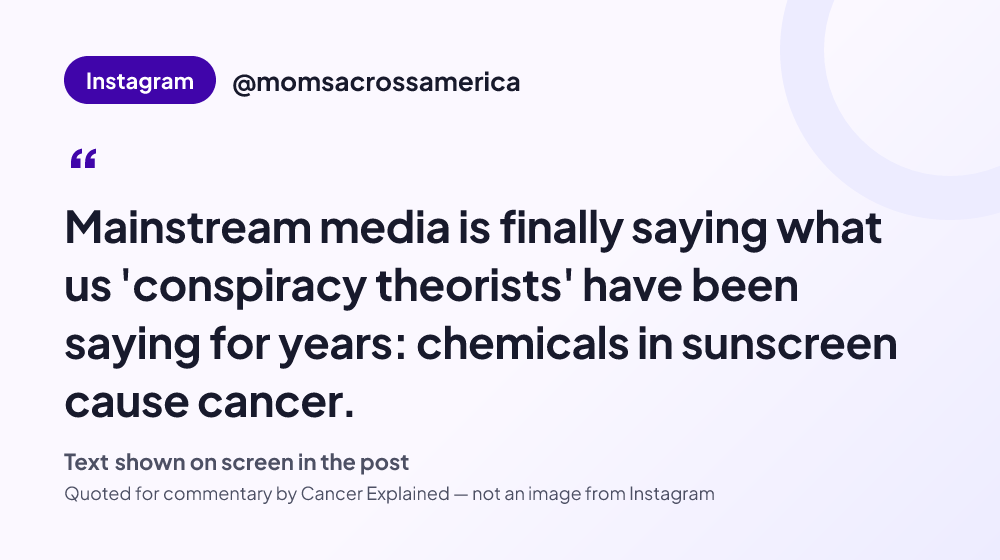
Claim: Sunscreen is more dangerous than the sun itself
A viral Instagram reel from @momsacrossamerica — a "natural health" group — claims sunscreen chemicals are a bigger threat than UV exposure. Instagram's login wall cuts off the caption. But the reel fits a bigger trend. Many social media posts now urge people to cut back on or skip sunscreen. They push unprotected "safe sun exposure" instead.
It's an appealing message. It sounds simpler and more "natural." It plays on distrust of an industry many people already doubt. But taken literally, it could push people to drop one of the few things known to cut skin damage from UV light. This claim is easy to share and tied to a disease that can often be prevented. That combination is exactly why it's worth checking carefully.
What's actually well established
UV radiation clearly causes skin cancer. Scientists don't debate this. The National Cancer Institute (NCI) notes that "UV exposure causes early aging and damage that can lead to skin cancer," whether from the sun, tanning beds, or sunlamps. Skin cancer types include basal cell carcinoma, squamous cell carcinoma, and melanoma (the most dangerous). Melanoma is much more likely to spread to other parts of the body than the other two.
NCI's public guidance recommends sunscreen with an SPF of at least 15 (some doctors suggest SPF 30). Reapply it every two hours, or after swimming or sweating. Pair it with shade, protective clothing, wide-brimmed hats, and avoiding peak UV hours (10 a.m.–4 p.m.). None of this guidance treats sunscreen chemicals as a bigger threat than sun exposure. The opposite is true. UV exposure is the established driver of skin cancer risk. These steps exist to cut that risk.
Where there's a real, narrower scientific conversation
To be fair to the worry behind the reel, there is a real research thread here — just a much smaller one. Some chemical sunscreen ingredients, like oxybenzone, enter the bloodstream at levels above the FDA's safety-testing threshold in FDA-funded studies. This led the FDA to ask for more safety data. That's a real research gap. It is not evidence that sunscreen causes cancer.
NCI's evidence review finds the proof that sunscreen prevents skin cancer is inadequate. It has been shown to prevent sunburn and precancerous keratoses. Results for squamous cell carcinoma are inconsistent. Trials have not shown a benefit for melanoma. NCI also notes that sunscreen may encourage more sun exposure.
None of that adds up to "sunscreen is riskier than the sun." Absorption questions concern specific chemical ingredients, not sun protection in general. They remain under active study, not settled findings of harm. Mineral sunscreens use zinc oxide or titanium dioxide instead of chemical filters — a reasonable choice for anyone who wants fewer chemical filters.
The bigger picture
Claims built on a real, narrow research question — like ongoing study of specific sunscreen ingredients — can be stretched into a much bigger, unsupported conclusion. That conclusion is that avoiding sunscreen is safer than using it. It isn't. UV exposure is an established cause of skin cancer. No credible evidence supports skipping sun protection to lower cancer risk. For someone who wants to limit chemical exposure, the evidence-based answer isn't to go without protection. It's to choose mineral sunscreens, seek shade, wear protective clothing, and limit time in peak UV hours. That combination is what public health guidance has long recommended.
Sources
- NCI: Cancer Risk Factors – Sunlight
- NCI: Skin Cancer (Including Melanoma) — Patient Version
- NCI: Skin Cancer Prevention (PDQ®) — Health Professional Version
- Instagram reel, @momsacrossamerica
How this article was prepared
An AI-assisted editorial system helped prepare this page. No named medical reviewer has reviewed it unless one is listed.
Cancer Explained is published by the National Cancer Information Foundation. It is not medical advice and does not suggest a test or treatment.
See an error, old source, or unclear wording? Tell us.
Put the story in context
Prevention, possible warning signs, screening, and diagnosis
This story relates to Sunscreen safety claims, UV exposure, and skin cancer risk. The information below is general, and not every point applies to every cancer. Personal advice depends on age, symptoms, family history, exposures, and medical history.
Prevention and risk reduction
Not every cancer can be prevented. Avoiding tobacco, protecting skin from ultraviolet radiation, limiting alcohol, staying active, and receiving recommended HPV or hepatitis B vaccination can lower the risk of certain cancers. A risk factor is not a prediction or a cause in one individual.
Symptoms and possible early signs
Possible signs vary and are often caused by conditions other than cancer. Changes worth discussing include a new lump, unexplained bleeding or weight loss, a persistent cough, lasting bowel or bladder changes, a changing skin spot, or symptoms that persist or worsen. Some early cancers cause no symptoms.
Screening and early detection
Screening looks for certain cancers before symptoms begin. Recommended tests exist only for some cancers and depend on age and risk. Screening can have benefits and harms; it is not the same as evaluating a new symptom, and there is no single routine scan or blood test that reliably screens for every cancer.
How cancer is diagnosed
Diagnosis may involve a history and exam, imaging, laboratory tests, and often a biopsy. Pathology can identify the cancer type and may test biomarkers that guide treatment. Symptoms, screening results, tumor markers, or online stories alone cannot confirm cancer.
A news story may encourage questions, but it should not be used to estimate your risk or choose testing. Contact a healthcare professional about a persistent or concerning change. Seek urgent care for severe or rapidly worsening symptoms.