
NewsTrending topic
Does Olive Oil Really Lower Breast Cancer Risk? What the PREDIMED-Style Research Actually Shows
A viral post claims olive oil dramatically cuts breast cancer risk, citing Mediterranean-diet research. Here's what the actual studies found, and how far the evidence really goes.
Original commentary from the Cancer Explained editorial team.


Please note: this page is educational only — it is not medical advice, and it does not speculate about anyone’s health beyond reliable public reporting. For questions about your own health, talk with your healthcare team.
“Women using olive oil had 65 percent less breast cancer than the low fat group.”
Nothing has loaded from Instagram. We do not connect you to Meta unless you ask, because that would let them set cookies through this page. Open it on Instagram instead.
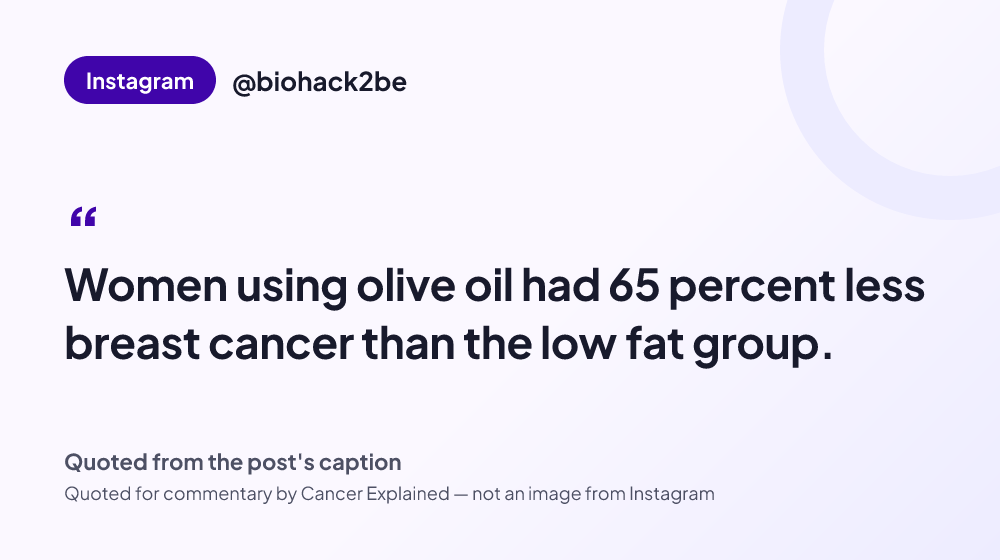
A post claims olive oil substantially lowers breast cancer risk, pointing to Mediterranean-diet research. There is real, respected science behind a Mediterranean diet with extra-virgin olive oil and breast cancer risk. But the social-media summary claims more certainty than the research actually supports.
What the actual research found
The best-known study behind this claim is PREDIMED, a large, well-regarded randomized trial in Spain. It compared a Mediterranean diet with extra-virgin olive oil (or nuts) against a lower-fat control diet, mainly to study heart health. A follow-up look at that trial found a real drop in breast cancer cases among women on the olive-oil Mediterranean diet, compared to the control group. This is genuine, peer-reviewed, randomized trial evidence. That's a stronger form of evidence than most nutrition claims can point to.
What the claim tends to leave out
Breast cancer was a secondary outcome in PREDIMED. The trial's main goal was preventing heart disease. The number of breast cancer cases in that subgroup was fairly small. That limits how precisely researchers can measure the risk drop. Other trials need to repeat the finding, with breast cancer as the main outcome this time. The diet studied was a whole pattern: high olive oil intake as part of an overall Mediterranean diet rich in vegetables, legumes, fish, and nuts. It wasn't olive oil alone, or large extra doses outside that pattern. It's also a group-level, long-term effect. It's not a guarantee for any one person. It doesn't mean olive oil treats existing breast cancer.
Why this is still a legitimately encouraging finding
Unlike many viral supplement claims, this one rests on a real randomized trial with a secondary finding. A Mediterranean-style diet is also well-supported on its own for heart health and overall wellness, with very low downside. That mix sets this apart from most claims this site fact-checks: a real trial record and low risk of harm.
What to do with this information
A Mediterranean-style diet, with regular extra-virgin olive oil as your main fat source, is a reasonable, well-supported choice for overall health. It's unlikely to cause harm for most people. Think of it as one contributor to lower average population risk. It's not a guaranteed personal prevention plan or a treatment. It doesn't replace recommended breast cancer screening for your age and risk group. Talk to your doctor about your own screening schedule.
How this article was prepared
An AI-assisted editorial system helped prepare this page based on National Cancer Institute guidance on diet and cancer risk and publicly available findings from the PREDIMED trial's breast cancer sub-analysis, and the original social media post. No named medical reviewer has reviewed it unless one is listed.
Cancer Explained is published by the National Cancer Information Foundation. It is not medical advice and does not suggest a test or treatment.
See an error, old source, or unclear wording? Tell us.
Put the story in context
Prevention, possible warning signs, screening, and diagnosis
This story relates to Breast cancer. The information below is general, and not every point applies to every cancer. Personal advice depends on age, symptoms, family history, exposures, and medical history.
Prevention and risk reduction
Not every cancer can be prevented. Avoiding tobacco, protecting skin from ultraviolet radiation, limiting alcohol, staying active, and receiving recommended HPV or hepatitis B vaccination can lower the risk of certain cancers. A risk factor is not a prediction or a cause in one individual.
Symptoms and possible early signs
Possible signs vary and are often caused by conditions other than cancer. Changes worth discussing include a new lump, unexplained bleeding or weight loss, a persistent cough, lasting bowel or bladder changes, a changing skin spot, or symptoms that persist or worsen. Some early cancers cause no symptoms.
Screening and early detection
Screening looks for certain cancers before symptoms begin. Recommended tests exist only for some cancers and depend on age and risk. Screening can have benefits and harms; it is not the same as evaluating a new symptom, and there is no single routine scan or blood test that reliably screens for every cancer.
How cancer is diagnosed
Diagnosis may involve a history and exam, imaging, laboratory tests, and often a biopsy. Pathology can identify the cancer type and may test biomarkers that guide treatment. Symptoms, screening results, tumor markers, or online stories alone cannot confirm cancer.
Learn more about breast cancer
A news story may encourage questions, but it should not be used to estimate your risk or choose testing. Contact a healthcare professional about a persistent or concerning change. Seek urgent care for severe or rapidly worsening symptoms.