
NewsPublic figure
What Gordon Ramsay's Skin Cancer Story Can Teach Us About Sun Safety
Chef Gordon Ramsay shared a basal cell carcinoma diagnosis in 2025 and urged fans to wear sunscreen. Here is a calm, plain-language look at skin cancer and prevention, drawn from the National Cancer Institute.
A plain-language summary based on public reporting and trusted sources, linked below.

Please note: this page is educational only — it is not medical advice, and it does not speculate about anyone’s health beyond reliable public reporting. For questions about your own health, talk with your healthcare team.
A sunscreen reminder disguised as a joke
Gordon Ramsay posted on Instagram that he had a basal cell carcinoma removed. BBC News and NBC News both reported the post, and he named the type himself.
"Grateful and so appreciative for the incredible team at The Skin Associates and their fast reactive work on removing this Basal Cell Carcinoma thank you!" he wrote. Then came the line that did the actual work: "Please don't forget your sunscreen this weekend." He added, "I promise you it's not a face lift! I'd need a refund."
The BBC reported that he was 58 and that Cancer Research UK thanked him for "raising awareness of how important it is to stay safe in the sun." That is the entire public account, and it is enough to build on, because he named a specific diagnosis.
Basal cell carcinoma is not melanoma
This is the distinction the word "skin cancer" hides. The National Cancer Institute describes the main types as basal cell carcinoma, squamous cell carcinoma, and melanoma. The first two are grouped together as nonmelanoma skin cancer.
Nonmelanoma skin cancer is the most common cancer in the United States. NCI reports that basal cell carcinoma accounts for about three-quarters of it. Because these cancers are not reported to registries, exact counts do not exist. NCI cites an estimate that about 3.3 million people were treated for nonmelanoma skin cancer in 2012, a figure exceeding all other new cancer cases combined.
The outcome is different too. NCI states that although nonmelanoma skin cancer is the most common of all malignancies, "it accounts for less than 0.1% of patient deaths caused by cancer."
NCI describes basal cell carcinomas as slow growing tumors that "rarely metastasize." The catch is in the next sentence. BCC "tends to be locally destructive and can result in serious deforming damage if left untreated or if local recurrences cannot be completely excised."
That is why the location on the face — the BBC described a dressing underneath his ear — and the speed of treatment matter. NCI names the central face, around the eyes, the nose, behind the ears, the ear canal, forehead, and scalp as high-risk areas for recurrence after treatment.
How it is removed
NCI lists the approaches for basal cell carcinoma as excision, radiation therapy, cryosurgery, electrodesiccation and curettage, light-based treatments, and topical drugs. Each fits particular situations, and NCI reports that "depending on case selection, these approaches produce recurrence-free rates ranging from 85% to 95%."
Two options are worth knowing by name. Standard surgical excision removes the tumor with a margin of 3 to 10 millimeters of normal skin, and a pathologist checks whether that margin is clear. NCI notes the limits of that check honestly. In one trial, 18 percent of primary BCCs were incompletely excised at the first operation and needed a second. Many labs examine only a fraction of the total margin, so a report of clear margins "can be subject to sampling error."
Mohs micrographic surgery is the alternative. The tumor is removed in thin layers, and each layer is examined under a microscope during the operation until no cancer remains. It is generally used for high-risk sites on the face, where sparing tissue and confirming complete removal both matter.
Squamous cell carcinoma behaves differently
The other common nonmelanoma cancer deserves its own paragraph. NCI states that squamous cell carcinomas "are more aggressive than BCCs and have a range of growth, invasive, and metastatic potential."
NCI names the people at higher risk: those with chronic sun damage, a history of sunburns, arsenic exposure, long-standing skin ulcers, or previous radiation therapy. These tumors turn up on the ears, the lower lip, and the backs of the hands.
When to get checked
For an existing mole, NCI gives four features to watch, plus two changes that always warrant attention.
- Asymmetry, where one half does not match the other
- A border that is ragged, notched, or blurred
- Uneven color, with black, brown, tan, or patches of white, gray, red, pink, or blue
- A change in size, usually growth, and most melanomas are wider than 6 millimeters
- A mole that starts to itch
- A mole that bleeds or oozes
NCI adds that "often the first sign of melanoma is a change in the shape, color, size, or feel of an existing mole," and that melanoma may also appear as an entirely new unusual patch of skin. For nonmelanoma cancers, watch for a new bump, a scaly patch, or a sore that keeps not healing, especially on the face, ears, neck, or hands.
Prevention that measurably works
NCI's sun guidance is specific enough to act on today.
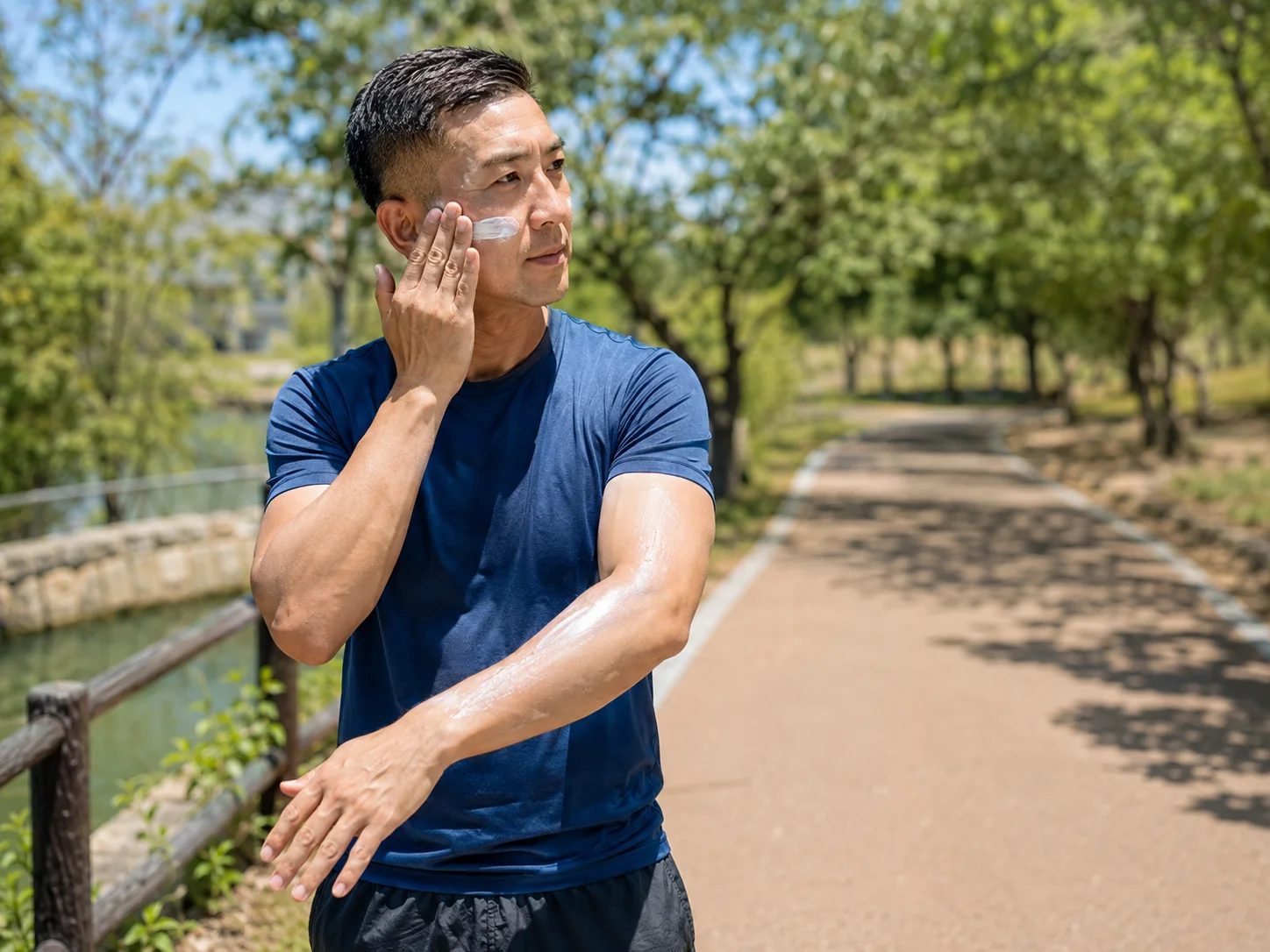
Limit time in the sun, especially from mid-morning to late afternoon. Remember that UV radiation reflects off sand, water, snow, and ice, and passes through windshields and windows. Wear a hat with a wide brim all the way around, because baseball caps and visors leave the ears and neck exposed. Wear sunglasses that block UV.
On sunscreen, NCI advises an SPF of at least 15, and notes that some doctors suggest at least 30. "Apply sunscreen to uncovered skin 30 minutes before going outside and again every two hours or after swimming or sweating." Avoid tanning beds entirely.
NCI also makes a point that gets missed. Skin cancer is more common in people with light skin, but "people of all skin tones can develop skin cancer, including those with dark skin."
The melanoma numbers, for contrast
An estimated 112,000 new melanoma cases and 8,510 melanoma deaths are expected in the United States in 2026 — American Cancer Society projections, carried on SEER's stat facts page. SEER's own measured rate of new cases is 22.3 per 100,000 people per year, and the death rate is 2.0 per 100,000.
Five-year relative survival for melanoma is 94.7 percent overall, and SEER reports that 76.9 percent are diagnosed while still local, where five-year relative survival is 100.0 percent.
Those numbers reward early detection more clearly than almost any other cancer. They are also group statistics, and SEER says plainly that they "cannot be used to predict exactly what will happen to an individual patient."
Sources
- https://www.bbc.co.uk/news/articles/ce93lp8d9xro
- https://www.nbcnews.com/pop-culture/pop-culture-news/gordon-ramsay-skin-cancer-diagnosis-rcna228177
- https://www.cancer.gov/types/skin/hp/skin-treatment-pdq
- https://www.cancer.gov/types/skin/moles-fact-sheet
- https://www.cancer.gov/about-cancer/causes-prevention/risk/sunlight
- https://seer.cancer.gov/statfacts/html/melan.html
Know someone who needs this?
Plenty of people are looking for something like this and do not know where to start. If this would help a friend or someone you love, send it on — we have written an opening line so you do not have to stare at an empty message. You can change every word of it.
Your message is written and sent in your own email or messaging app — we never see who you send it to, and nothing is added to any list.
Put the story in context
Prevention, possible warning signs, screening, and diagnosis
This story relates to Skin cancer (basal cell carcinoma). The information below is general: it does not reveal anything else about a public person’s health, and not every point applies to every cancer. Personal advice depends on age, symptoms, family history, exposures, and medical history.
Prevention and risk reduction
Not every cancer can be prevented. Avoiding tobacco, protecting skin from ultraviolet radiation, limiting alcohol, staying active, and receiving recommended HPV or hepatitis B vaccination can lower the risk of certain cancers. A risk factor is not a prediction or a cause in one individual.
Symptoms and possible early signs
Possible signs vary and are often caused by conditions other than cancer. Changes worth discussing include a new lump, unexplained bleeding or weight loss, a persistent cough, lasting bowel or bladder changes, a changing skin spot, or symptoms that persist or worsen. Some early cancers cause no symptoms.
Screening and early detection
Screening looks for certain cancers before symptoms begin. Recommended tests exist only for some cancers and depend on age and risk. Screening can have benefits and harms; it is not the same as evaluating a new symptom, and there is no single routine scan or blood test that reliably screens for every cancer.
How cancer is diagnosed
Diagnosis may involve a history and exam, imaging, laboratory tests, and often a biopsy. Pathology can identify the cancer type and may test biomarkers that guide treatment. Symptoms, screening results, tumor markers, or online stories alone cannot confirm cancer.
Learn about this story’s cancer topic
A public story may encourage questions, but it should not be used to estimate your risk or choose testing. Contact a healthcare professional about a persistent or concerning change. Seek urgent care for severe or rapidly worsening symptoms.