
NewsTrending topic
Dr. Eric Berg's Instagram Fenbendazole Claim: What the Evidence Actually Shows
An Instagram post from Dr. Eric Berg, DC, says a $5-a-dose dewormer helped stage 4 cancer patients reach complete remission, and that no one will study a drug that cheap. Here's what's actually been tested — and what ASCO says about it.
Original commentary from the Cancer Explained editorial team.


Please note: this page is educational only — it is not medical advice, and it does not speculate about anyone’s health beyond reliable public reporting. For questions about your own health, talk with your healthcare team.
“A parasitic worm medication reportedly helping stage 4 cancer patients achieve remission for approximately $5 per dose. Major cancer centers avoid conducting clinical trials because patents have expired years ago.”
Nothing has loaded from Instagram. We do not connect you to Meta unless you ask, because that would let them set cookies through this page. Open it on Instagram instead.
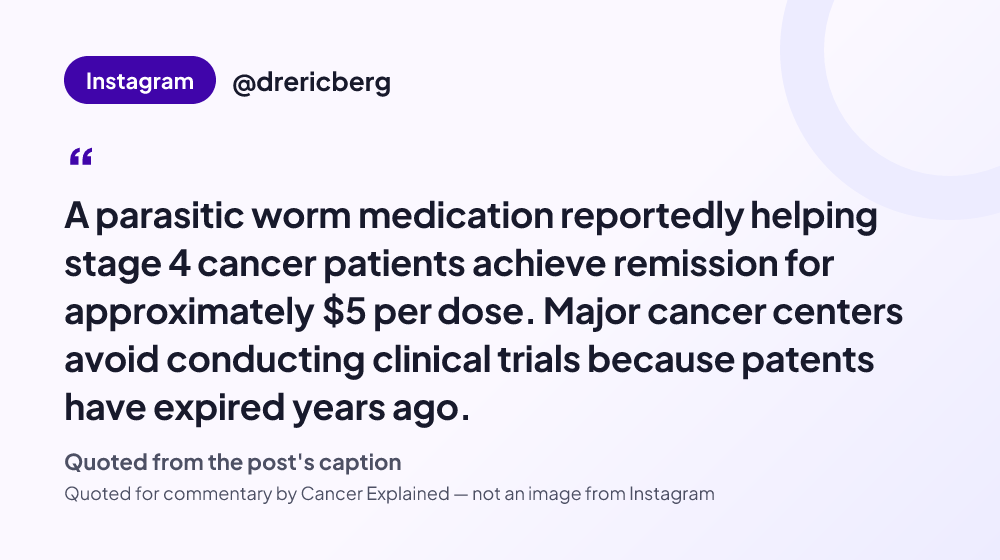
A viral Instagram post from Dr. Eric Berg, DC, makes a striking claim. It says a drug sold to deworm dogs has brought stage 4 cancer patients to complete remission, for about $5 a dose. The post argues no drug company will spend $100 million testing a cure that cheap. Its patent expired long ago. So there's no profit in it, the post says. It links to a free diet guide in his bio. A small disclaimer on the post notes one thing. Dr. Berg holds a Doctor of Chiropractic degree, not a medical degree.
This is a version of a claim we've covered before, from a different messenger. See Mel Gibson's Fenbendazole Claim on Joe Rogan for that one. The "cheap generic drug the industry won't touch" idea comes up often enough to address directly.
What's real
Fenbendazole and mebendazole are related drugs, both in the benzimidazole family. Both have shown some anti-cancer activity in lab dishes and in animal studies. That early research is real. It hasn't been retracted. Mebendazole is a close relative. It's approved for human use, unlike fenbendazole. It has gone further too. A small 2022 randomized trial tested it in 40 people with metastatic colorectal cancer. It was published in the journal Life Sciences (Hegazy et al.). Adding mebendazole to standard chemo (bevacizumab plus FOLFOX4) showed anti-tumor activity. It also lowered a tumor-growth marker, compared with adding a placebo. That's a real, published, human result.
It's also true that a drug with an expired patent has no company positioned to fund it. Large clinical trials are very costly. That's a genuine gap in how drug research gets funded. But a funding gap is not the same thing as proof the drug works.
What's missing
Here's what the post doesn't say. We found no human trial showing that fenbendazole — the drug in the post, not mebendazole — treats any cancer. Mebendazole's own human data is limited. The 2022 colorectal trial had only 40 people.
A "$5 a dose, complete remission" claim about specific patients isn't something we can check from a social media post. Stories like it can't rule out simpler explanations. Maybe standard treatment worked. Maybe the cancer was already responding. Maybe the timeline is remembered generously. Patients in these stories are often, though not always, still getting standard treatment at the same time. That makes it hard to credit one drug alone.
In May 2026, the American Society of Clinical Oncology (ASCO) put out a formal Clinical Notice. It recommends against using ivermectin or fenbendazole to treat cancer. That's true alone or alongside standard treatment, outside a registered clinical trial. ASCO's reasoning is simple: there's no strong, peer-reviewed proof either drug is safe or works against any human cancer. Using them anyway carries a real risk of toxicity and drug interactions, for no proven benefit.
What to do with this
If you or someone you love is thinking about fenbendazole, mebendazole, or any unapproved drug alongside cancer treatment, tell your care team before you start. This isn't about talking you out of it. Any drug can interact with chemo, radiation, or other medicines in ways that matter for your safety. That's true even for a drug sold over the counter or for pets. A viral post, however sincere, isn't a substitute for that talk.
Sources
- ASCO, Clinical Notice on ivermectin and fenbendazole for cancer treatment, issued May 2026: ASCO Connection
- Hegazy et al., "Mebendazole; from an anti-parasitic drug to a promising candidate for drug repurposing in colorectal cancer," Life Sciences, 2022: PubMed
- National Cancer Institute, "Complementary and Alternative Medicine": cancer.gov
- Cancer Explained, "Mel Gibson's Fenbendazole Claim on Joe Rogan": /news/fenbendazole-mel-gibson-joe-rogan-claim-fact-check/
How this article was prepared
An AI-assisted editorial system helped prepare this page, using ASCO's published clinical notice, the peer-reviewed Hegazy et al. trial on PubMed, and National Cancer Institute guidance. No named medical reviewer has reviewed it unless one is listed.
Cancer Explained is published by the National Cancer Information Foundation. It is not medical advice and does not suggest a test or treatment.
See an error, old source, or unclear wording? Tell us.
Put the story in context
Prevention, possible warning signs, screening, and diagnosis
The information below is general, and not every point applies to every cancer. Personal advice depends on age, symptoms, family history, exposures, and medical history.
Prevention and risk reduction
Not every cancer can be prevented. Avoiding tobacco, protecting skin from ultraviolet radiation, limiting alcohol, staying active, and receiving recommended HPV or hepatitis B vaccination can lower the risk of certain cancers. A risk factor is not a prediction or a cause in one individual.
Symptoms and possible early signs
Possible signs vary and are often caused by conditions other than cancer. Changes worth discussing include a new lump, unexplained bleeding or weight loss, a persistent cough, lasting bowel or bladder changes, a changing skin spot, or symptoms that persist or worsen. Some early cancers cause no symptoms.
Screening and early detection
Screening looks for certain cancers before symptoms begin. Recommended tests exist only for some cancers and depend on age and risk. Screening can have benefits and harms; it is not the same as evaluating a new symptom, and there is no single routine scan or blood test that reliably screens for every cancer.
How cancer is diagnosed
Diagnosis may involve a history and exam, imaging, laboratory tests, and often a biopsy. Pathology can identify the cancer type and may test biomarkers that guide treatment. Symptoms, screening results, tumor markers, or online stories alone cannot confirm cancer.
A news story may encourage questions, but it should not be used to estimate your risk or choose testing. Contact a healthcare professional about a persistent or concerning change. Seek urgent care for severe or rapidly worsening symptoms.
Related Cancer Explained resources
Go deeper with NCI
Watch the short version
Under a minute, captioned, and sourced from federal health agencies.
Pressing play loads the video from YouTube’s privacy-enhanced player (youtube-nocookie.com). Nothing loads from YouTube before then. Educational only, not medical advice.