
NewsTrending topic
Dolph Lundgren's Cancer Story: What to Know Beyond the Viral Version
A viral post recounts actor Dolph Lundgren's cancer journey and the routine he credits for his recovery. Here's context on his real, publicly documented diagnosis and treatment, and what to take from his story.
Original commentary from the Cancer Explained editorial team.


Please note: this page is educational only — it is not medical advice, and it does not speculate about anyone’s health beyond reliable public reporting. For questions about your own health, talk with your healthcare team.
“Doctors told Dolph Lundgren he had 2 to 3 years left to live, with tumours on his liver, lungs, spine, and kidneys. 9 years later he is cancer-free. Here is exactly what he did.”
Nothing has loaded from Instagram. We do not connect you to Meta unless you ask, because that would let them set cookies through this page. Open it on Instagram instead.
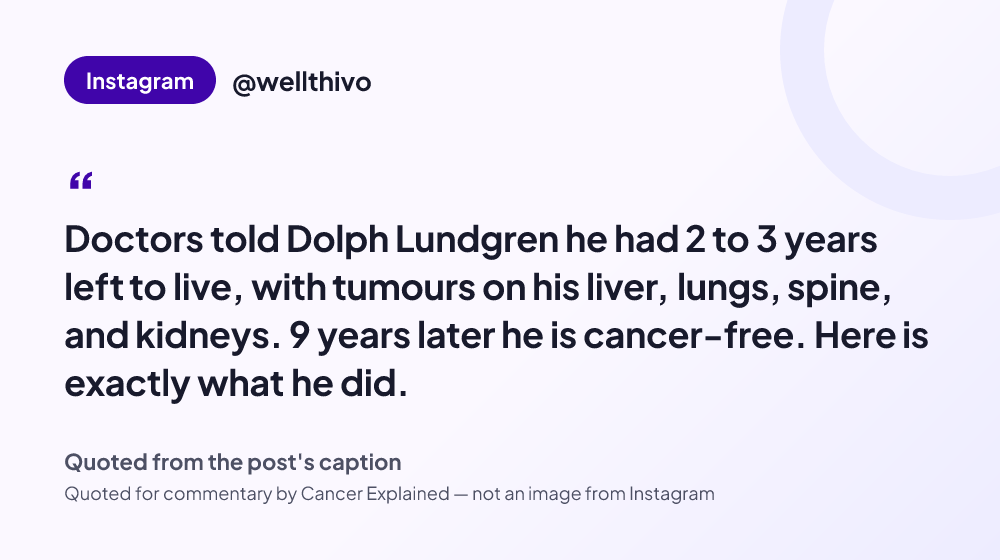
A post from wellthivo describes actor Dolph Lundgren's cancer journey. Doctors removed a kidney tumor in 2015. A scan in 2020 found the cancer had spread to his liver, lungs, stomach, and spine. Doctors gave him a prognosis of two to three years. He got a second opinion at UCLA. There, doctors found a genetic mutation in his tumor. That mutation allowed for targeted therapy. By late 2024, Lundgren announced he was cancer-free. He has also spoken publicly about past steroid use.
What's confirmed publicly
Lundgren has spoken about this journey in his own interviews for several years. The broad story matches what he has said in public. This includes his first kidney cancer diagnosis, the later spread of the cancer, the switch to targeted therapy after genetic testing, and finally being declared cancer-free.
Targeted therapy is a real and standard part of cancer care today. It works for kidney cancer and many other cancer types. Doctors don't use one treatment for everyone. Instead, they test the tumor's genes. Then they match the patient with a drug built to target that specific mutation.
What to keep in perspective
One celebrity's story is encouraging. But it is still just one data point. It is not proof that his exercise routine, supplements, or diet made his cancer respond to treatment. His targeted therapy is the clearest documented medical reason for his outcome. An oncology team matched that therapy to his tumor's genetic profile.
The lifestyle habits in his story — strength training, meditation, specific meals — are reasonable wellness habits during cancer treatment. But no source we opened shows they shrank his tumor.
What to do with this information
A story like this might raise questions about your own or a loved one's kidney cancer treatment. If so, ask your oncologist about genetic or biomarker testing of the tumor. This testing is used for some advanced cancers. It can open up targeted therapy options that did not exist even ten years ago.
How this article was prepared
An AI-assisted editorial system helped prepare this page. It used Dolph Lundgren's public interviews and the original social media post. No named medical reviewer has reviewed it unless one is listed.
Cancer Explained is published by the National Cancer Information Foundation. This page is not medical advice. It does not suggest any test or treatment.
See an error, old source, or unclear wording? Tell us.
Put the story in context
Prevention, possible warning signs, screening, and diagnosis
This story relates to Kidney cancer. The information below is general: it does not reveal anything else about a public person’s health, and not every point applies to every cancer. Personal advice depends on age, symptoms, family history, exposures, and medical history.
Prevention and risk reduction
Not every cancer can be prevented. Avoiding tobacco, protecting skin from ultraviolet radiation, limiting alcohol, staying active, and receiving recommended HPV or hepatitis B vaccination can lower the risk of certain cancers. A risk factor is not a prediction or a cause in one individual.
Symptoms and possible early signs
Possible signs vary and are often caused by conditions other than cancer. Changes worth discussing include a new lump, unexplained bleeding or weight loss, a persistent cough, lasting bowel or bladder changes, a changing skin spot, or symptoms that persist or worsen. Some early cancers cause no symptoms.
Screening and early detection
Screening looks for certain cancers before symptoms begin. Recommended tests exist only for some cancers and depend on age and risk. Screening can have benefits and harms; it is not the same as evaluating a new symptom, and there is no single routine scan or blood test that reliably screens for every cancer.
How cancer is diagnosed
Diagnosis may involve a history and exam, imaging, laboratory tests, and often a biopsy. Pathology can identify the cancer type and may test biomarkers that guide treatment. Symptoms, screening results, tumor markers, or online stories alone cannot confirm cancer.
Learn more about kidney cancer
A public story may encourage questions, but it should not be used to estimate your risk or choose testing. Contact a healthcare professional about a persistent or concerning change. Seek urgent care for severe or rapidly worsening symptoms.