
NewsTrending topic
Are Dandelion Root and Lemongrass Cancer Cures Being 'Buried'? Fact-Checking a Viral Claim
A viral Instagram post claims lab studies on dandelion root and lemongrass against cancer cells are being suppressed. Here's what the actual published research shows and doesn't show.
Original commentary from the Cancer Explained editorial team.


Please note: this page is educational only — it is not medical advice, and it does not speculate about anyone’s health beyond reliable public reporting. For questions about your own health, talk with your healthcare team.
“TWO STUDIES FIND DANDELION ROOT AND LEMONGRASS SUPPRESS HUMAN CANCER GROWTH IN MICE BY 95%. Health Canada approved human cancer trials for dandelion root in 2012, then it was BURIED.”
Nothing has loaded from Instagram. We do not connect you to Meta unless you ask, because that would let them set cookies through this page. Open it on Instagram instead.
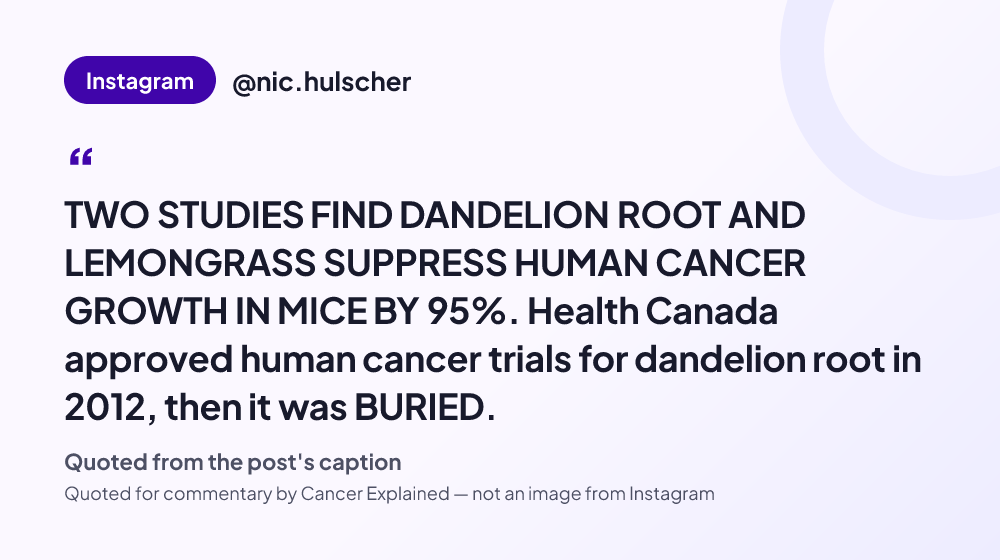
A post making the rounds claims that studies on dandelion root extract and lemongrass killing cancer cells have been sitting "buried" in scientific journals for years. It implies the findings are being deliberately suppressed. This is a common structure in cancer misinformation. First, cite a real lab finding. Then frame the lack of a follow-up cure as a cover-up, instead of what it usually is: how early-stage research actually works.
What the real research shows
Published laboratory studies do exist. Most come from university research groups. They test dandelion root extract and, separately, lemongrass-derived compounds against cancer cells grown in a dish (in vitro), and in some cases in animal models. Some of these studies report that the extracts can trigger cell death in certain cancer cell lines under lab conditions. This is real, publicly available, peer-reviewed research. It isn't secret, and it isn't buried. It's indexed and searchable on PubMed, the National Institutes of Health's own public research database.
Why "found in a lab dish" hasn't become "approved cancer treatment"
The National Cancer Institute is direct about this gap. It states there are no studies proving that any herb, supplement, or natural compound can slow, cure, or prevent the recurrence of cancer in humans.
Most compounds that show activity against cancer cells in a petri dish never make it through the next stages. First comes animal safety testing, then Phase 1 human safety trials. Then come larger trials proving real benefit outweighs risk in people. That's not suppression. It's the normal, high attrition rate of drug development, and it applies just as much to lab compounds from pharmaceutical companies as to plant extracts. Most never clear that bar. The reasons range from toxicity to simply not working as well in a living body as in a dish.
Why "buried" framing is a red flag on its own
Claiming that legitimate findings are being hidden is a rhetorical move. The truth is usually simpler: the finding just hasn't turned into an approved treatment yet, or never will. That framing discourages the more useful questions: has this been tested in animals? In humans? What did a follow-up study find, if one was attempted? Real unresolved or negative research is common and openly published. It's part of how science corrects itself, not evidence of a conspiracy.
What to do with this information
If a specific study is being cited, look it up directly on PubMed and read what it actually says. Usually it's a cell-culture or animal study that describes itself as preliminary. That's a very different claim than the "hidden cure" framing implies. If you're considering an herbal supplement alongside cancer treatment, tell your oncology team before you start it. Some plant compounds can interact with chemotherapy or radiation in ways that reduce how well they work or raise side effects.
How this article was prepared
An AI-assisted editorial system helped prepare this page based on National Cancer Institute guidance on complementary and alternative medicine and cancer myths, and the original social media post. No named medical reviewer has reviewed it unless one is listed.
Cancer Explained is published by the National Cancer Information Foundation. It is not medical advice and does not suggest a test or treatment.
See an error, old source, or unclear wording? Tell us.
Put the story in context
Prevention, possible warning signs, screening, and diagnosis
The information below is general, and not every point applies to every cancer. Personal advice depends on age, symptoms, family history, exposures, and medical history.
Prevention and risk reduction
Not every cancer can be prevented. Avoiding tobacco, protecting skin from ultraviolet radiation, limiting alcohol, staying active, and receiving recommended HPV or hepatitis B vaccination can lower the risk of certain cancers. A risk factor is not a prediction or a cause in one individual.
Symptoms and possible early signs
Possible signs vary and are often caused by conditions other than cancer. Changes worth discussing include a new lump, unexplained bleeding or weight loss, a persistent cough, lasting bowel or bladder changes, a changing skin spot, or symptoms that persist or worsen. Some early cancers cause no symptoms.
Screening and early detection
Screening looks for certain cancers before symptoms begin. Recommended tests exist only for some cancers and depend on age and risk. Screening can have benefits and harms; it is not the same as evaluating a new symptom, and there is no single routine scan or blood test that reliably screens for every cancer.
How cancer is diagnosed
Diagnosis may involve a history and exam, imaging, laboratory tests, and often a biopsy. Pathology can identify the cancer type and may test biomarkers that guide treatment. Symptoms, screening results, tumor markers, or online stories alone cannot confirm cancer.
A news story may encourage questions, but it should not be used to estimate your risk or choose testing. Contact a healthcare professional about a persistent or concerning change. Seek urgent care for severe or rapidly worsening symptoms.